When a car hits a bike, the rider takes the impact. Then the driver's insurer often starts asking what the rider did wrong. The Sookiassian Firm, Ltd. helps people hurt while cycling piece together what happened in the crash and handles the insurers while they heal.
Weren't on a bike when it happened? If you were inside a vehicle, see our car accident lawyer page. If you were on foot, see our pedestrian accident lawyer page. If you were riding a motorcycle, see our motorcycle accident lawyer page.
What to do after a bicycle crash in Las Vegas
The minutes after a bike crash are confusing, and you may be hurt worse than you feel. If you can, go through these steps, or ask someone riding with you to help.
- Get medical care. Call 911 if anyone is hurt. A blow to the head or a hard landing can cause injuries that don't show right away, so get checked even if you rode or walked away.
- Call the police and get a number. Ask the officer for the report or event number before you leave. Depending on where you were riding, the agency that responds may be LVMPD, Henderson Police, North Las Vegas Police, or the Nevada Highway Patrol.
- Take pictures. Photograph the road, the lane markings, the signals, the vehicle and where it stopped, your bicycle where it landed, and your injuries. Keep taking photos of your injuries over the next few days.
- Collect names. Get the driver's name, insurance and plate number. Ask bystanders for their names and phone numbers. If you were on a group ride, ask the other riders too.
- Save your ride data and footage. Don't delete the ride from your bike computer or phone app. Download any handlebar or helmet camera video as soon as you can.
- Leave the bike and gear as they are. Don't repair the bicycle, throw away the helmet, or wash your clothing until everything has been photographed and examined.
- Be careful what you say to insurers. An adjuster may call quickly and ask for a recorded statement. Before you agree, read about talking to an insurance adjuster or call us.
How bike crashes with cars happen
No two crashes are the same, but some patterns keep showing up where drivers and people on bikes share a road:
- Close passes. A driver passes a rider without leaving enough room and clips the handlebar or forces the rider off the road.
- Right hooks. A driver passes a rider and then turns right across the rider's path, often into a driveway or side street.
- Left turns across the rider. An oncoming driver turns left without seeing the rider coming straight through the intersection.
- Dooring. Someone in a parked car swings a door open just as a rider comes alongside.
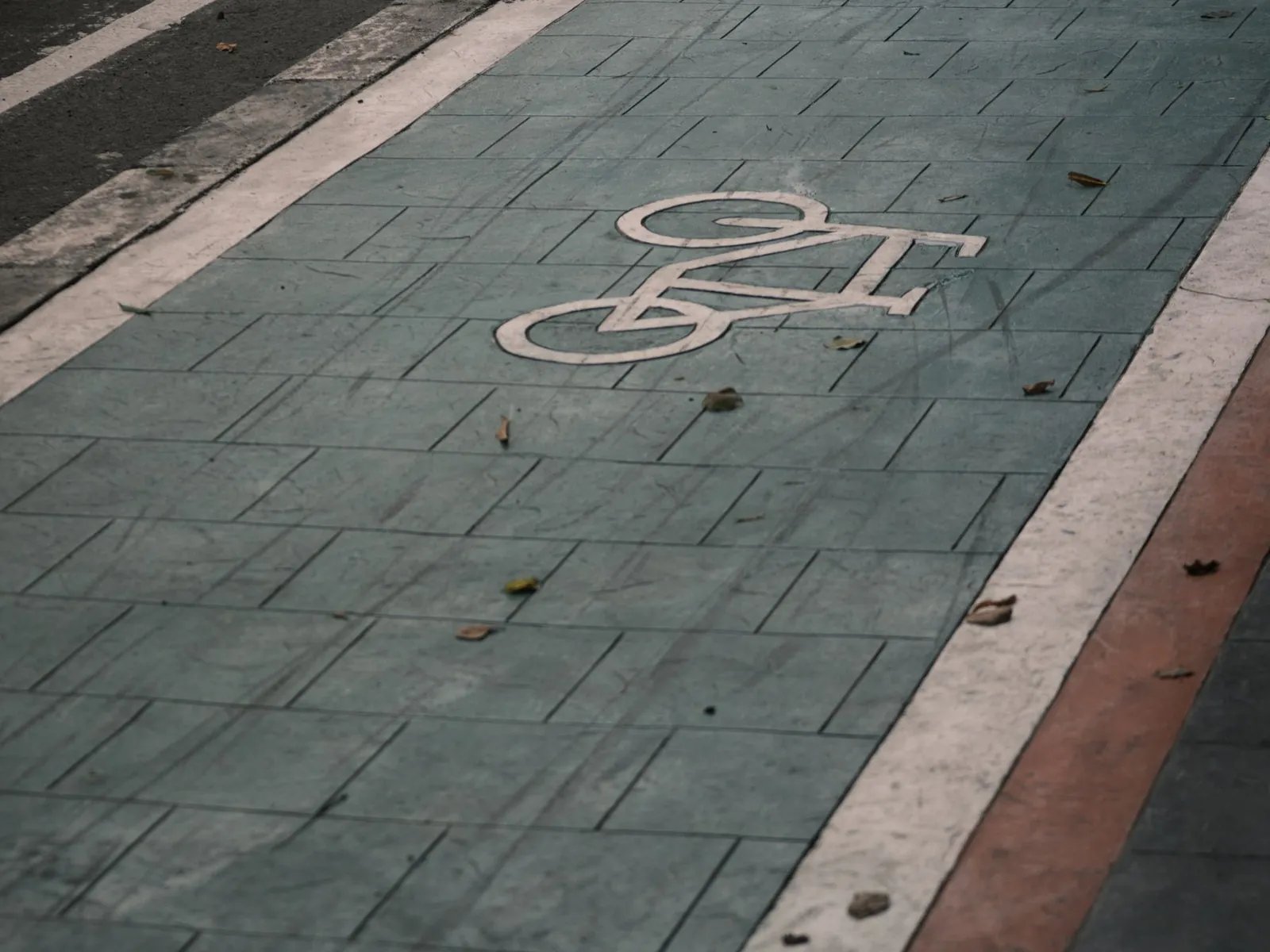
- Drivers in the bike lane. A driver drifts into a bike lane, or crosses it to park or turn, and hits the rider there.
- Driveways and parking lots. A driver pulls out of a driveway, a shopping center exit or a parking lot without looking for a rider in the street.
People ride in the valley all year. Commuters ride Las Vegas Blvd, Sahara Ave and Flamingo Rd. Neighborhood riders use Rampart Blvd, Hualapai Way and Town Center Dr. Road riders head out W. Charleston Blvd and SR 159 toward Red Rock Canyon. Many ride early in the morning or in the evening to avoid the heat. At dawn and dusk the sun sits low, and a driver facing into it may have trouble seeing a rider ahead.
If you were visiting, rented a bike, and have since gone home, you can still work with us by phone. Our guide for visitors hurt in Las Vegas covers what changes when you live out of state.
Nevada road rules that can matter in a bicycle claim
Nevada's traffic laws set duties for both drivers and riders. In brief:
- Riders count as vehicle operators. A person riding a bicycle on a roadway generally has the rights and duties of a driver of a vehicle (NRS 484B.763).
- Passing a rider. A driver passing a person on a bike must use due care and move into the lane to the left when one is available and it's reasonably safe. On a road with one lane in that direction, the driver must pass at a safe distance of at least 3 feet (NRS 484B.270).
- Bike lanes. Drivers must yield to riders in a bike lane and generally may not drive, stop or park in it, with limited exceptions such as entering or leaving a driveway or alley, or avoiding other traffic (NRS 484B.270).
- Lane position. Riders are generally expected to keep toward the right side of the road when it's practicable, with exceptions, such as when keeping up with nearby traffic, preparing to turn left, or when hazards or a narrow lane make it unsafe (NRS 484B.777).
- Lights at night. A bicycle ridden at night needs a white front light, a red rear reflector, and reflective material or lights visible from the sides (NRS 484B.783).
These are short summaries. A fuller guide to Nevada's bicycle rules is coming soon on our blog.
Who may be responsible
More than one person or company can share the blame for a bike crash. Depending on the facts, that may include:
- The driver. A driver who doesn't take reasonable care around a person on a bicycle may be responsible for the harm.
- The driver's employer. If the driver was working at the time, for example making deliveries, the business they worked for may also be responsible.
- A rideshare driver. If the car was a rideshare vehicle, there are separate insurance questions. See our rideshare accident lawyer page.
- The person who opened a door. A driver or passenger who opens a door into a rider's path may be responsible. Nevada law bars opening a door on the traffic side of a vehicle in a way that interferes with moving traffic (NRS 484B.153).
- A government entity. If a road defect or road design contributed to the crash, the government entity responsible for the road may share liability. Claims against government entities are subject to special procedural rules and notice requirements under Nevada law.
- A parts maker. If a defective bicycle part failed and helped cause the crash, the company that made it may share responsibility.
When the insurer blames the rider
Insurers sometimes open by asking what the rider did wrong. They may say you weren't wearing a helmet, had no lights, were too far into the lane, or were riding on the sidewalk. None of those points settles the claim. The real question is still what each person did, and whether the driver used reasonable care.
Nevada follows a comparative fault rule (NRS 41.141). You can recover compensation even if you were partially at fault, as long as your share of fault is 50 percent or less. A share of more than 50 percent bars recovery, and your recovery is reduced by your percentage of fault. Our post on Nevada's comparative negligence rule (NRS 41.141) explains how fault is divided.
Accident reconstruction can help show how a crash happened.
Evidence that helps a bicycle claim
A car crash leaves two damaged vehicles to compare. A bike crash often doesn't, so other proof matters more. Riders often have more of it than they realize.
- Ride data. A bike computer, sports watch or GPS ride app can record your speed, your route and the time of the crash. That data can help answer claims that you were going too fast or came out of nowhere. Export or back up the file before it's overwritten by a sync or deleted.
- Camera video. A handlebar or helmet camera may show the driver's turn, the pass or the door. Save the original file, not just a clip.
- Your lights. If your front or rear light was on, keep it. Some lights also record video or keep a log, so save whatever yours stored.
- The bicycle and gear. Keep the frame, fork, wheels, helmet, shoes, clothing and accessories in the condition the crash left them. Photograph each item. Ask a bike shop for a written repair or replacement estimate, but don't have the repair done yet.
- Nearby video. Businesses, homes and traffic cameras near the crash may have recorded it. Video may not be kept for long, so ask early.
- Group-ride witnesses. Riders who were with you saw the crash from the road. Get each person's name and phone number before the group splits up.
What a bicycle injury claim can include
A claim can cover the losses the crash caused. Depending on the facts, that may include:
- medical bills, now and in the future
- income you lost while you couldn't work
- pain and suffering
- your bicycle, helmet, clothing and other gear
Our guide to what an injury claim can include in Nevada explains each category. If the crash left you with a lasting or life-changing injury, see our catastrophic injury lawyer page. If you lost a family member, our wrongful death lawyer page explains who may bring a claim.
Every claim depends on its own facts, and no one can put a value on yours before reviewing them.
Insurance after a bike crash
In most cases, the first place to look is the at-fault driver's liability insurance. Your own auto policy may cover you even while cycling, depending on its terms. That matters when the driver had little or no insurance. Our uninsured motorist lawyer page explains how that coverage works.
How we handle bicycle accident claims
Once you hire us, we take on the work that is hard to manage while you recover:
- Records requests. We request the police report and related records from the agency that handled the crash.
- Preservation letters. We write to nearby businesses and property owners and ask them to keep any video that may show the crash.
- Witness contact. We contact bystanders and other riders while their memories are fresh.
- Ride data. We collect your bike computer files, app data and camera footage, and keep copies.
- Insurer contact. We keep a list of every insurer involved, often both the driver's and your own, and handle the calls and letters.
- Medical records and bills. We track your treatment, records and bills so the claim shows what your injuries have cost.
- Updates. We tell you what has happened on your claim and what comes next.
We provide personalized attention to every client. Attorney Jaklin Sookiassian, the firm's founding attorney, spent 2 years at Fried Frank, an AmLaw 100 firm in New York.
Deadlines
In Nevada, you generally have two years from the date of the injury to file a personal injury lawsuit (NRS 11.190(4)(e)). Claims against government entities are subject to special procedural rules and notice requirements under Nevada law. To learn how the deadline works, read about Nevada's statute of limitations for injury claims.
Bicycle accident FAQs
Talk with us about your bike crash
Tell us what happened, and bring what you have: the event number, photos, ride data, and the names of anyone who saw the crash.
No attorney's fee unless we recover compensation for you. You may still be responsible for costs.
The Sookiassian Firm, Ltd.
1980 Festival Plaza Dr, Suite 460, Las Vegas, NV 89135 (Downtown Summerlin)
Monday–Sunday, 8:00 AM–6:00 PM · Call (702) 518-8584
Serving Las Vegas, Summerlin, Henderson and North Las Vegas.
We speak English, Armenian, Russian, and Farsi (Persian).