
If you've been injured in an accident in Las Vegas, one of the first things the insurance company will try to do is argue that the accident was partly — or even mostly — your fault. Their goal is simple: reduce what they owe you or avoid paying altogether.
But being partially at fault for an accident doesn't necessarily mean you lose your right to compensation. Nevada follows a legal doctrine called modified comparative negligence, governed by Nevada Revised Statutes (NRS) 41.141. This law determines how fault is divided between the parties involved in an accident and how that division affects the amount of money you can recover.
Understanding how comparative negligence works in Nevada is critical for anyone considering a personal injury claim. The difference between being found 49% at fault and 51% at fault is the difference between receiving compensation and receiving nothing.
Were You Partially at Fault?
Don't let an insurance company use comparative negligence against you. Contact The Sookiassian Firm at (702) 518-8584 for a free consultation.
What Is Comparative Negligence?
Comparative negligence is a legal framework used to assign fault when more than one party contributed to an accident. Rather than treating fault as an all-or-nothing question, comparative negligence recognizes that accidents are often the result of mistakes by multiple people.
For example, imagine you're driving through an intersection in Las Vegas when another driver runs a red light and hits your car. However, at the time of the collision, you were checking your phone. Both drivers share some degree of responsibility — but the other driver clearly bears more of the blame.
Comparative negligence allows a court or jury to assign a specific percentage of fault to each party and adjust the damages accordingly.
Not every state handles comparative negligence the same way. There are three main approaches used across the country:
Pure Comparative Negligence: A plaintiff can recover damages no matter how much of the accident was their fault, even if they were 99% responsible. Their award is simply reduced by their percentage of fault. States like California and New York follow this model.
Pure Contributory Negligence: If the plaintiff bears any fault at all — even 1% — they are completely barred from recovering damages. Only a handful of states still follow this harsh rule.
Modified Comparative Negligence: This is the middle ground, and it's the system Nevada uses. A plaintiff can recover damages only if their share of fault does not exceed a certain threshold.
How Nevada's Modified Comparative Negligence Works Under NRS 41.141
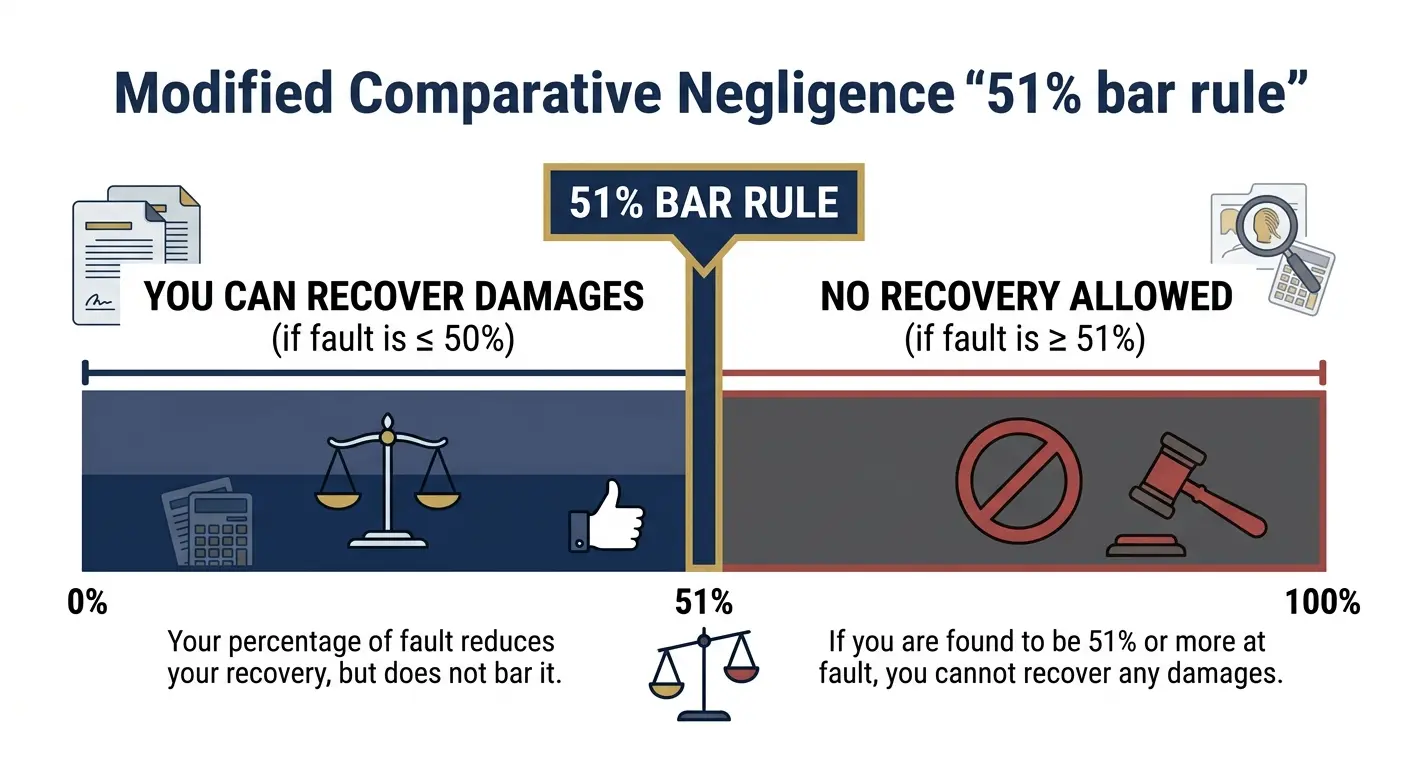
Nevada's comparative negligence law is codified in NRS 41.141. The statute establishes what is sometimes called the "51% bar rule" — you can recover compensation as long as you are not more at fault than the defendant (or the combined fault of multiple defendants).
If your fault is 50% or less, you can still recover damages. However, your total compensation will be reduced by your percentage of fault.
If your fault is 51% or more, you are completely barred from recovering any compensation, regardless of how severe your injuries are.
The law requires the jury to take two steps when comparative negligence is at issue:
- Determine total damages — The jury first calculates the full value of the plaintiff's damages as if the plaintiff had no fault at all.
- Assign fault percentages — The jury issues a special verdict that assigns a specific percentage of fault to each party involved.
The plaintiff's final award is then reduced by their assigned percentage of fault.
Examples of How NRS 41.141 Applies
Example 1 — You're 30% at fault:
You're involved in a car accident on I-15 near the Spaghetti Bowl. The jury determines your total damages are $100,000. They also find that you were 30% at fault (perhaps you were exceeding the speed limit) and the other driver was 70% at fault (they changed lanes without signaling). Your recovery would be reduced by 30%, meaning you would receive $70,000.
Example 2 — You're 50% at fault:
You slip and fall on a wet floor at a Las Vegas casino. The jury finds the casino was 50% at fault for failing to place a warning sign, and you were 50% at fault for not paying attention. Your damages total $50,000. Because your fault does not exceed the defendant's fault, you can still recover — but your award is reduced to $25,000.
Example 3 — You're 51% at fault:
You're rear-ended at a stoplight, but the jury determines that your brake lights were not functioning at the time. The jury assigns you 51% of the fault and the other driver 49%. Despite suffering $200,000 in medical bills and lost wages, you would recover nothing under Nevada law.
Comparative Negligence With Multiple Defendants
Accidents don't always involve just two parties. Nevada law accounts for situations involving multiple defendants, and the rules under NRS 41.141 become especially important in these cases.
When there are multiple defendants, the plaintiff's fault is compared to the combined negligence of all defendants. This can work in the plaintiff's favor.
Multi-Defendant Example:
You're in a three-car pileup on US-95. The jury finds you 40% at fault, Defendant A 35% at fault, and Defendant B 25% at fault. The combined fault of both defendants is 60%. Because your 40% is less than 60%, you can still recover. Your $100,000 in damages would be reduced by 40%, and you would receive $60,000.
Several Liability in Nevada
Under NRS 41.141, Nevada follows a several liability model when there are multiple defendants. This means each defendant is only responsible for paying their individual share of the damages — not the total amount.
There is an important exception: if the defendants were engaged in concerted acts — meaning they were acting together intentionally — joint and several liability may apply, making each defendant responsible for the full amount.
How Fault Is Determined in Nevada
Nevada law doesn't provide a specific formula for assigning fault percentages. Instead, fault is determined based on the evidence presented in each case. Types of evidence that typically influence fault allocation include:
- Police reports documenting the responding officer's observations and conclusions
- Witness testimony from people who saw the accident happen
- Surveillance or dashcam footage capturing the incident
- Accident reconstruction analysis performed by expert witnesses
- Medical records documenting the nature and timing of injuries
- Cell phone records showing whether a party was distracted at the time of the accident
- Physical evidence such as skid marks, vehicle damage patterns, and road conditions
Common Scenarios Where Comparative Negligence Comes Into Play
Comparative negligence can arise in virtually any type of personal injury case in Nevada. Here are some of the most common scenarios Las Vegas residents encounter:
Car Accidents
A driver runs a red light and hits you, but you weren't wearing your seatbelt. The jury might assign you a percentage of fault, arguing your injuries would have been less severe if you had been buckled up. Learn more about car accident claims in Las Vegas.
Truck Accidents
You merge onto I-15 and are struck by an 18-wheeler. The trucking company argues you merged too quickly without checking your mirrors. Even if the truck driver was fatigued or speeding, your share of fault will reduce your recovery. Read about truck accident claims in Las Vegas.
Motorcycle Accidents
A car fails to yield and turns left in front of your motorcycle. The defendant argues you were exceeding the speed limit. If the jury agrees you were partially at fault, your damages are reduced. Learn about your rights after a motorcycle accident in Nevada.
Pedestrian Accidents
You're crossing the street in a marked crosswalk when a car strikes you. The defendant argues you were on your phone and wearing dark clothing at night. Read about pedestrian accident laws in Las Vegas.
Slip and Fall Accidents
You slip on a wet floor in a grocery store. The store failed to clean up the spill or post a warning sign, but you were also wearing sandals and walking quickly. Learn more about slip and fall claims in Las Vegas.
Dog Bites
A neighbor's dog bites you while you're walking past their property. The owner argues that you provoked the dog by reaching through the fence. Read about dog bite claims in Las Vegas.
How Insurance Companies Use Comparative Negligence Against You
Insurance companies are well aware of how Nevada's comparative negligence law works, and they use it strategically to minimize payouts. Some common tactics include:
- Shifting blame early: Adjusters may call you shortly after an accident and ask leading questions designed to get you to admit partial fault. Even casual statements like "I probably should have been paying closer attention" can be used against you later.
- Inflating your fault percentage: The insurance company's goal is to push your assigned fault as high as possible. If they can argue you were 51% at fault, they pay nothing.
- Using recorded statements: Insurance adjusters may request a recorded statement. Anything you say in that statement can be used to argue you were partially responsible for the accident.
- Disputing medical evidence: If you delayed seeking medical treatment after the accident, the insurer may argue your injuries were pre-existing or not caused by the accident.
Exceptions to Nevada's Comparative Negligence Rule
There are several situations where Nevada's comparative negligence framework may not apply or where special rules come into play:
- Intentional misconduct: Comparative negligence applies to negligent (careless) conduct, not intentional acts. If the defendant deliberately caused you harm, they generally cannot reduce their liability by arguing you were partly at fault.
- Children under 7: Nevada law treats children under the age of 7 as legally incapable of negligence. A defendant cannot use comparative negligence as a defense when the injured party is a young child.
- Illegal activity: If the injured party was engaged in illegal activity at the time of the accident, Nevada courts may bar their recovery entirely, depending on the specific circumstances.
- Government entities: Claims against government agencies in Nevada are subject to special notice requirements and procedural rules under the Nevada Tort Claims Act (NRS Chapter 41).
The Statute of Limitations Still Applies
Regardless of how fault is divided, Nevada's statute of limitations sets a strict deadline for filing a personal injury lawsuit. Under NRS 11.190, you generally have two years from the date of your injury to file a claim.
If you miss this deadline, the court will almost certainly dismiss your case — even if the other party was 100% at fault. The statute of limitations runs regardless of ongoing medical treatment, insurance negotiations, or any other factor.
How to Protect Your Claim and Minimize Your Assigned Fault
- Do not admit fault at the scene — Even if you think you may have contributed to the accident, avoid making statements that could be interpreted as admissions of fault.
- Seek medical attention immediately — Prompt treatment documents the connection between the accident and your injuries.
- Preserve evidence — Take photos of the accident scene, your injuries, and any relevant conditions. Save dashcam footage if available.
- Do not give recorded statements to insurance companies — You are not required to provide a recorded statement to the other party's insurer. Politely decline and direct them to your attorney.
- Contact a personal injury attorney — An experienced attorney understands how comparative negligence works in practice and can build a case that minimizes your share of fault.
Why Legal Representation Matters in Comparative Negligence Cases
Comparative negligence cases are not straightforward. The percentage of fault assigned to you directly determines how much money you receive — or whether you receive anything at all. A shift of just a few percentage points can mean tens of thousands of dollars in lost compensation.
At The Sookiassian Firm, attorney Jaklin Sookiassian has the experience and legal knowledge to navigate the complexities of Nevada's modified comparative negligence system. From investigating the facts of your accident to challenging inflated fault allegations by insurance companies, the firm works to protect your right to fair compensation.
Get a Free Consultation Today
Contact The Sookiassian Firm at (702) 518-8584. We handle personal injury cases on a contingency fee basis.No attorney's fee unless we recover compensation for you. You may still be responsible for costs.
Frequently Asked Questions About Comparative Negligence in Nevada
Can I still file a personal injury claim if I was partially at fault for the accident?
Yes. Under NRS 41.141, you can recover damages as long as your share of fault is 50% or less. Your compensation will be reduced by your percentage of fault. For example, if you are found 20% at fault and your damages total $100,000, you would receive $80,000.
What happens if I am found 51% or more at fault?
If your fault exceeds 50%, you are completely barred from recovering any compensation under Nevada law. This is why it is critical to have an attorney who can present evidence to minimize your assigned fault percentage.
Who decides the fault percentages in a Nevada personal injury case?
In a jury trial, the jury assigns fault percentages to each party based on the evidence presented. In a bench trial (without a jury), the judge makes this determination. During settlement negotiations, fault percentages are negotiated between the attorneys and insurance companies involved.
Does comparative negligence apply to all types of personal injury cases in Nevada?
How do insurance companies use comparative negligence to reduce my settlement?
Insurance adjusters frequently try to shift blame to the injured party to reduce or eliminate their payout. They may use your own statements, surveillance footage, or gaps in your medical records to argue you were more at fault than you actually were. An experienced attorney can work to counter these tactics.

Jaklin Sookiassian
Jaklin Sookiassian is the founding attorney of The Sookiassian Firm, a Las Vegas personal injury and business law practice. She is admitted to the Nevada and New York bars and previously practiced corporate finance at Fried Frank in New York. Learn more about Jaklin.